

Most hiring mistakes do not happen because someone lacks skill. They happen because we overestimate interviews.
We like to believe that a strong conversation, a polished resume, and good instincts are enough to judge fit. I used to think that too. But over time, I realized interviews reward confidence and preparation. They do not always reveal how someone handles stress, conflict, structure, or collaboration once the real work begins.
That gap is exactly why pre-employment personality tests matter.
When used correctly, they do not replace interviews. They strengthen them. They bring structure to behavioral evaluation, reduce bias, and help you assess traits like conscientiousness, emotional stability, and teamwork in a consistent way.
In this guide, I will break down what a pre-employment personality test really is, which assessments are worth considering, and how to conduct one responsibly within your hiring process.
What Is a Pre-Employment Personality Test?
A pre-employment personality test is a structured assessment used to evaluate the behavioral tendencies of job candidates before a hiring decision is made.
It does not measure technical ability. It measures how someone is likely to behave at work.
These assessments help you understand patterns such as:
- Conscientiousness: reliability, discipline, follow-through
- Emotional stability: response to stress and pressure
- Agreeableness: cooperation and teamwork
- Extraversion: communication and social engagement
- Openness: adaptability and creativity
- Leadership inclination: influence and initiative
The objective is not to label candidates. It is to assess behavioral alignment with the role and team.
The most effective personality tests focus on stable traits, not temporary emotions. A person’s conscientiousness, for example, is far more predictive of performance than how they felt on a stressful day.
Results typically include:
- Trait-level scores
- Behavioral insights
- Guidance for follow-up interview questions
A pre-employment personality test is not a psychological diagnosis and should never function as a standalone hiring filter. It is a decision-support tool that strengthens structured evaluation.
Why Use Pre-Employment Personality Tests?
Personality assessments are most useful when you treat them as a practical hiring tool, not a personality label.
They help employers answer questions that interviews often leave unclear, like how a candidate approaches accountability, handles pressure, or works within a team structure.
Here is why many hiring teams rely on them:
- Bring consistency to behavioral evaluation: Instead of relying on different interviewers’ interpretations, personality tests create a standardized way to assess traits that matter across candidates.
- Identify strengths that are hard to spot early: Traits like conscientiousness, emotional stability, or adaptability often show up more clearly in structured assessments than in a short conversation.
- Support better role matching: Some candidates thrive in fast-paced, high-interaction roles, while others perform best in detail-oriented or independent work. Personality data helps align people with the environments where they are most likely to succeed.
- Improve decision-making across hiring panels: When multiple stakeholders are involved, assessment reports provide a shared reference point, reducing misalignment in how candidates are evaluated.
- Add structure to long-term workforce planning: Beyond screening, personality insights can support onboarding, coaching, and team development once the candidate is hired.
Used thoughtfully, personality testing helps employers make more informed decisions while building teams that work well together over time.
When Should Employers Use Personality Tests in the Hiring Process?
Timing matters.
Administer a personality test too early, and you risk frustrating qualified applicants. Administer it too late, and you miss the opportunity to use the results strategically in interviews.
Most employers integrate personality testing at these points in the hiring funnel:
| Hiring Stage | Why Use It Here | What It Enables |
|---|---|---|
| After Resume Screening | Confirms candidates meet baseline qualifications first | Adds behavioral insight without overwhelming applicants |
| Before Final Interviews | Allows hiring managers to review results in advance | Guides sharper, trait-focused follow-up questions |
| For High-Impact Roles | Evaluates stress tolerance, leadership tendencies, or client-facing temperament | Reduces risk in roles where behavioral fit is critical |
| During High-Volume Hiring | Applies the same criteria across large candidate pools | Maintains consistency and fairness at scale |
| For Internal Promotions | Assesses readiness for expanded responsibility | Adds behavioral context beyond tenure or performance metrics |
What to Avoid
- Sending personality tests before confirming technical qualifications
- Using test scores as automatic disqualifiers
- Failing to train interviewers on how to interpret results
Personality assessments are most effective when they sit in the middle of your hiring process. At that point, you already know the candidate can do the job. The question becomes how they will operate inside your team and environment.
That is the decision personality testing helps clarify.
What Employers Should Look for in a Good Personality Test
Not all personality assessments are suitable for hiring. Some are designed for self-awareness or team development, while others are built for structured evaluation in recruitment.
Before choosing a test, employers should evaluate it against a few key criteria:
| What to Look For | Why It Matters |
|---|---|
| Job relevance | The traits measured should directly connect to the demands of the role. Testing unrelated characteristics increases legal and hiring risk. |
| Validated framework | Assessments based on established models like the Big Five or HEXACO tend to be more reliable and defensible. |
| Clear scoring and reporting | Hiring teams need trait-level breakdowns and easy-to-read reports, not vague personality labels. |
| Customizability | The ability to tailor questions or scoring ensures alignment with company values and role expectations. |
A strong personality test does not simply categorize candidates. It provides structured, interpretable data that supports informed hiring decisions.
6 Most Trusted Pre-Employment Personality Tests for Hiring
Not every personality test is built for hiring. Employers need assessments that go beyond surface-level labels and offer structured insight into how a candidate is likely to work, communicate, handle pressure, and fit into a role over time.
Below are some of the most established personality frameworks used in professional recruitment today. Each one differs in how it is designed, what it measures, and how hiring teams typically apply the results.
1. Big Five Personality Model (Five-Factor Model)
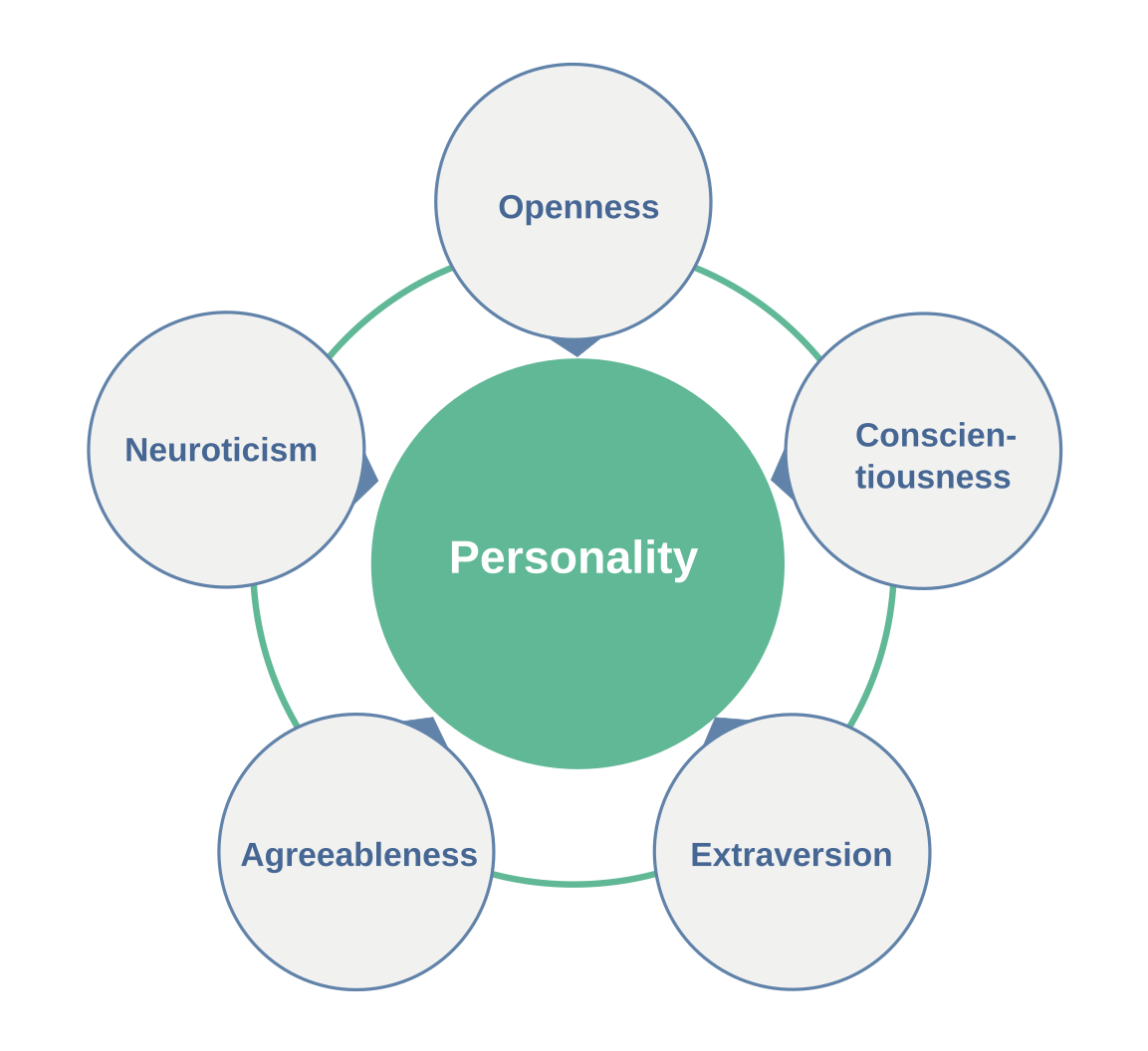
Image source: wikipedia.org/wiki/Big_Five_personality_traits
How It Works:
Candidates respond to a series of behavioral statements using an agreement scale, typically ranging from strongly disagree to strongly agree. Instead of assigning someone a fixed “type,” the test scores them across five major traits.
Core Traits Measured:
- Conscientiousness
- Emotional Stability
- Extraversion
- Agreeableness
- Openness
How Employers Use It:
The Big Five is one of the most widely researched models in workplace psychology. Conscientiousness is strongly linked to job performance across roles, while emotional stability often relates to how well someone handles stress and feedback. Employers use it to understand broad work style tendencies.
Strength: Strong research support and practical relevance.
Limitation: Offers high-level insight unless broken into more detailed sub-traits.
Big Five Assessment Breakdown:
- Number of questions: There is no official version of this test, so the number of questions can vary but is usually around 50-60.
- Time taken to complete: 10-15 minutes
- Number of traits tested: 5
- Question format: 5-point agreement scale
2. SHL Occupational Personality Questionnaire (OPQ)
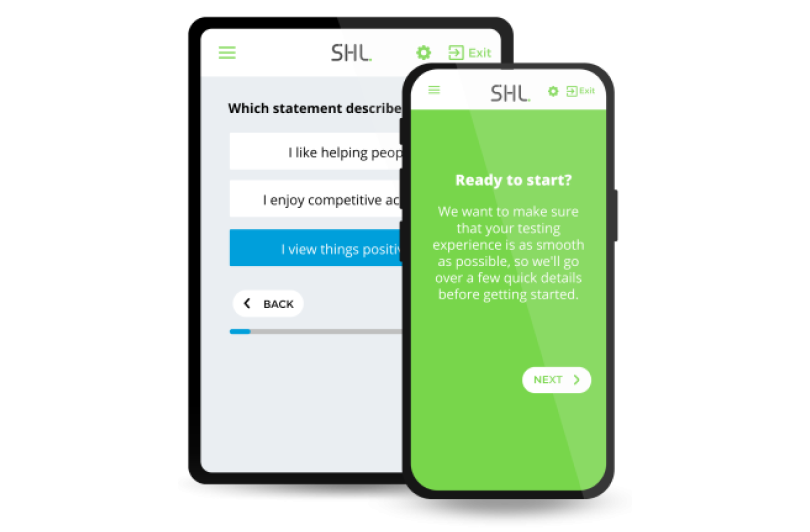
Image Source: shl.com
How It Works:
Candidates complete sets of statements and choose which ones are most and least like them. This makes it harder to simply select the “best-looking” answer and helps reveal genuine workplace preferences.
Core Traits Measured:
Workplace behaviors related to interpersonal style, thinking approach, and emotional response.
How Employers Use It:
OPQ is designed specifically for recruitment and often produces structured reports that connect traits to job behaviors. It is commonly used in larger hiring processes where multiple interviewers review results together.
Strength: Built for workplace selection with detailed reporting.
Limitation: Results need thoughtful interpretation, not quick judgment.
SHL OPQ Breakdown:
- Number of questions: 104
- Time taken to complete: Around 20 minutes
- Number of traits tested: 32
- Question format: You are presented with 3 statements, out of which you have to select one that is most true about you and one that is least true about you
3. Caliper Profile
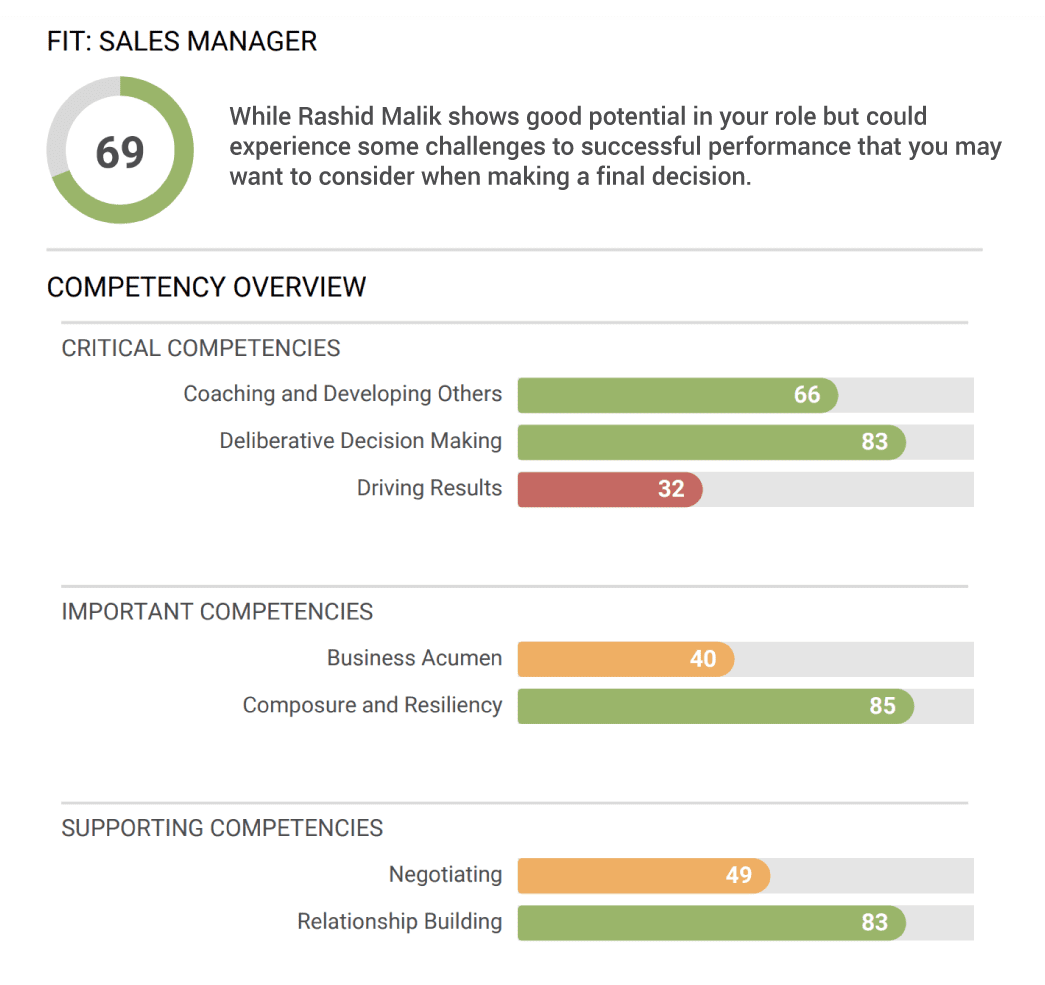
Image Source: calipercorp.com
How It Works:
The Caliper Profile combines different question styles, including agreement-based items and ranking choices. It builds a broad picture of how a candidate is likely to lead, collaborate, and perform under pressure.
Core Traits Measured:
Decision-making style, motivation, resilience, interpersonal effectiveness, and leadership tendencies.
How Employers Use It:
Often used in leadership or senior-level hiring where temperament and judgment matter as much as experience.
Strength: Provides deeper insight for high-responsibility roles.
Limitation: Longer than many other assessments.
The Caliper Profile Breakdown:
- Number of questions: 180
- Time taken to complete: 2-3 hours
- Number of traits tested: 22
- Question format: Multiple-choice, true/false, and 5-point agreement scale
4. Predictive Index Behavioral Assessment
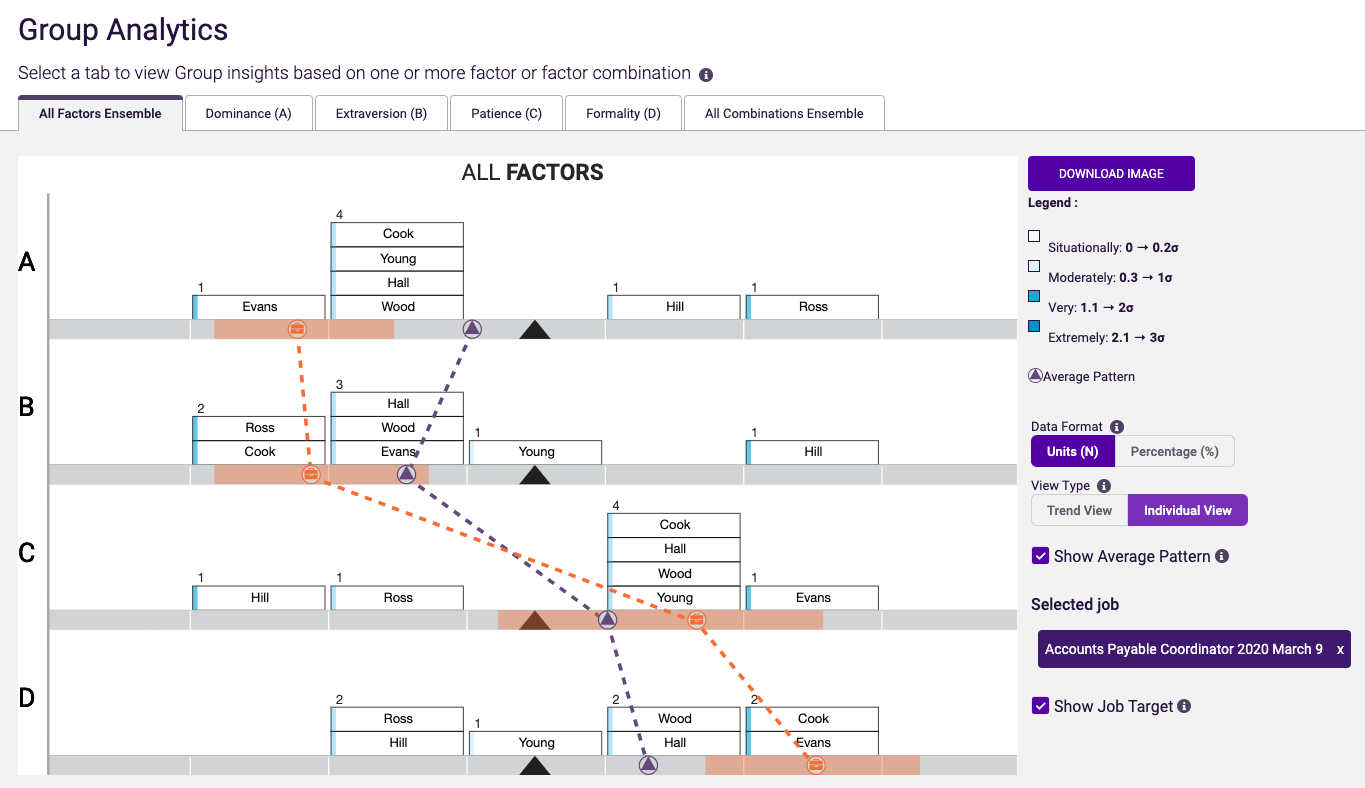
Image Source: predictiveindex.com
How It Works:
Candidates complete two adjective lists. One reflects how they believe others expect them to behave at work, and the other reflects how they naturally see themselves. The difference can highlight how someone adapts in professional settings.
Core Traits Measured:
Dominance, Extraversion, Patience, and Formality.
How Employers Use It:
Employers often use Predictive Index to compare candidates against the behavioral demands of a specific role, especially in fast-moving hiring environments.
Strength: Quick and easy to apply for role benchmarking.
Limitation: Focuses on a smaller set of work drives rather than a full personality picture.
PI Behavioral Assessment Breakdown:
- Number of questions: 50
- Time taken to complete: Around 10 minutes
- Number of traits tested: 6
- Question format: Checklist
5. 16PF Questionnaire
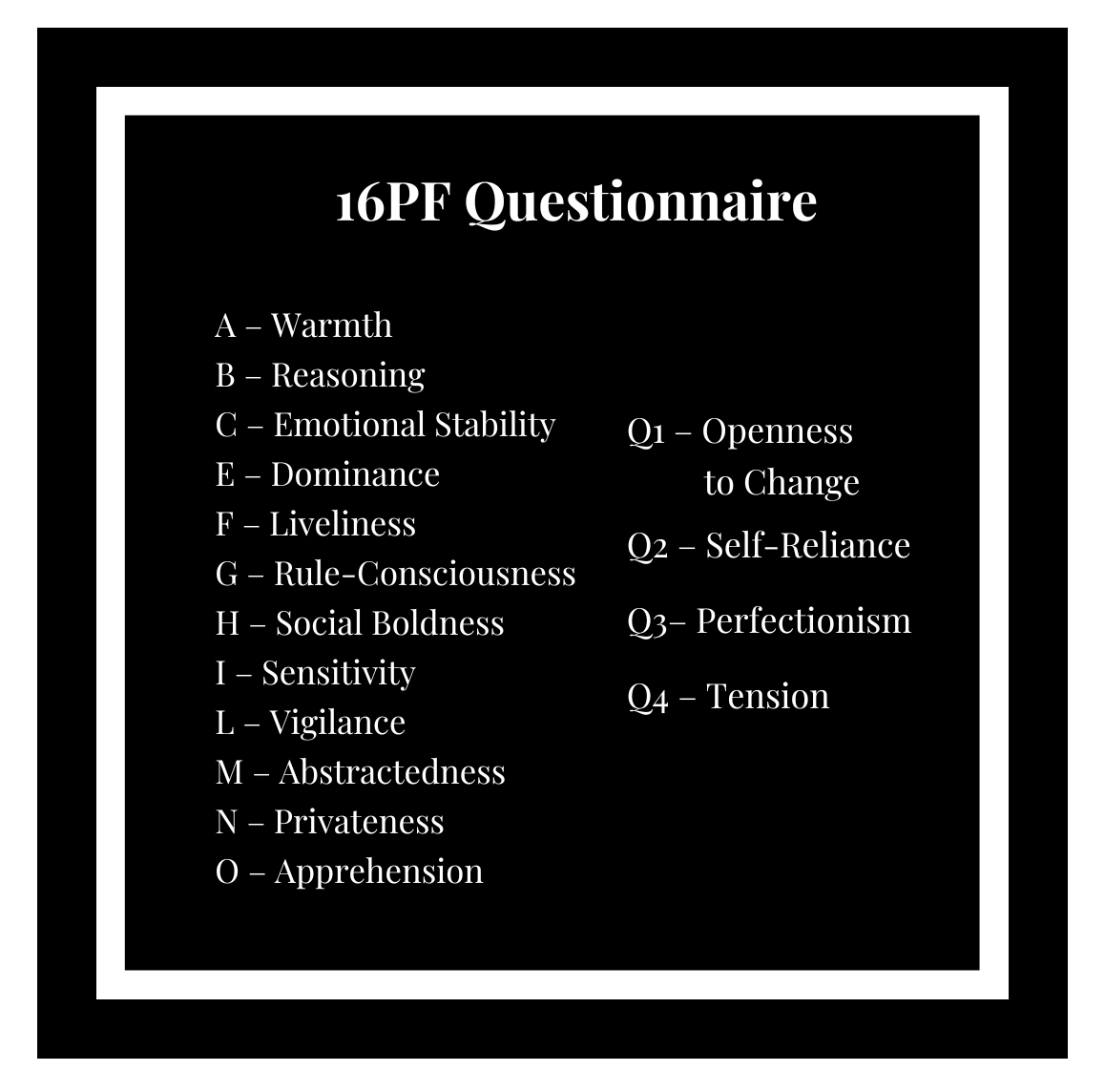
Image Source: personality-psychology.com
How It Works:
Candidates respond to a large set of statements, producing scores across sixteen personality traits. This gives a more detailed view than broader models like the Big Five.
Core Traits Measured:
Traits related to collaboration, independence, adaptability, emotional control, and stress response.
How Employers Use It:
Used when employers want deeper behavioral detail, especially for roles where work style differences can affect performance.
Strength: More detailed trait coverage.
Limitation: Requires careful role alignment to avoid overreading results.
16PF Questionnaire Breakdown:
- Number of questions: 185
- Time taken to complete: Around 30 minutes
- Number of traits tested: 16
- Question format: 5-point agreement scale
6. HEXACO Personality Inventory
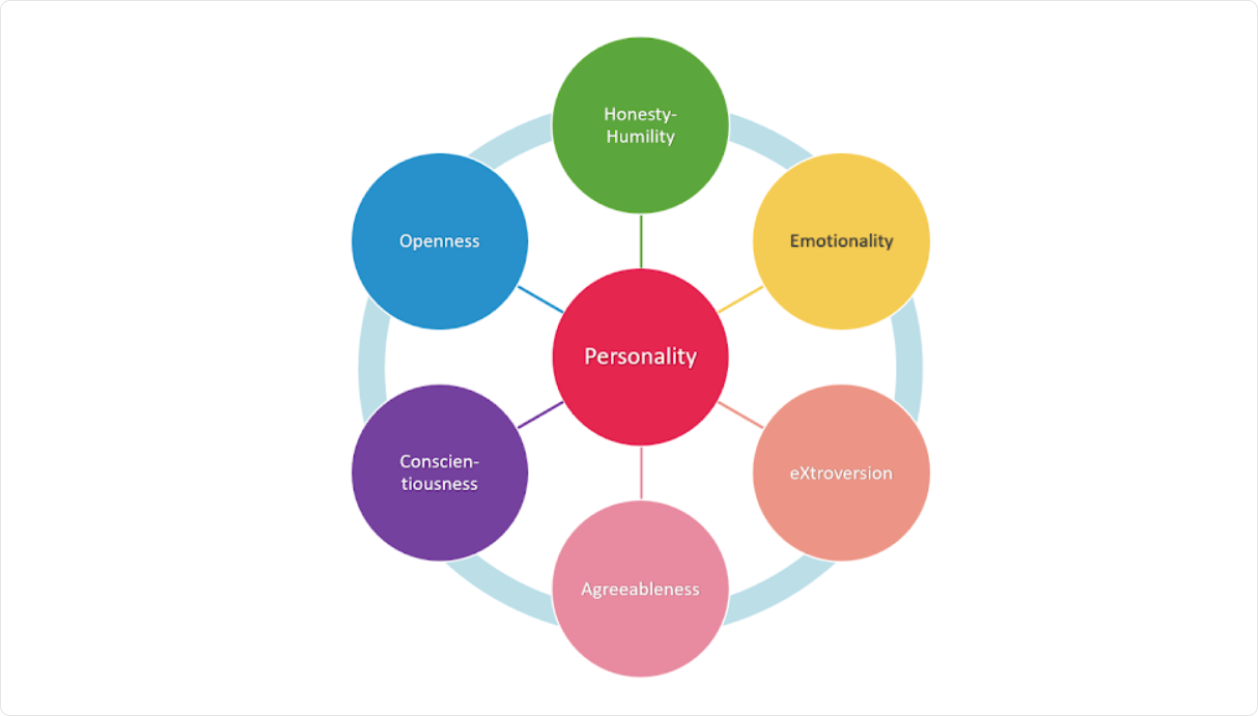
Image source: wikipedia.org/wiki/HEXACO_model_of_personality_structure
How It Works:
HEXACO uses agreement-based statements similar to the Big Five but adds an additional trait focused on honesty and humility.
Core Traits Measured:
Honesty-Humility, Emotionality, Extraversion, Agreeableness, Conscientiousness, and Openness.
How Employers Use It:
Employers may consider HEXACO in roles where integrity, fairness, and ethical behavior are especially important, such as finance, compliance, or high-trust positions.
Strength: Adds an integrity-focused dimension.
Limitation: Not necessary for every hiring context.
HEXACO Personality Inventory Breakdown:
- Number of questions: 200/100/60
- Time taken to complete: Around 15 minutes for the 100-question format
- Number of traits tested: 6 main traits, 24 sub-traits
- Question format: 5-point agreement scale
If you want a quick way to compare these frameworks based on how employers typically use them, the table below summarizes the main differences at a glance:
| Framework | Question Format | Best For | Key Insight Provided |
|---|---|---|---|
| Big Five | Agreement statements | General hiring | Broad work style and reliability traits |
| SHL OPQ | Most/least choice sets | Structured hiring panels | Workplace behavior patterns |
| Caliper Profile | Mixed formats | Leadership roles | Judgment, influence, resilience |
| Predictive Index | Adjective checklists | Fast role benchmarking | Core work drives and pace |
| 16PF | Agreement statements | Detailed differentiation | Deeper trait-level insight |
| HEXACO | Agreement statements | High-trust roles | Integrity and fairness orientation |
How to Create a Custom Pre-Employment Personality Test
While interviews reveal what candidates say, personality testing helps you understand how they are likely to behave. Let’s look at how to create a custom pre-employment personality assessment, aligned with specific job requirements, using ProProfs Quiz Maker as an example.
Step 1: Create a Personality Quiz
From your dashboard:
- Click Create a Quiz
- Open the Personality Templates tab
- Select Create Your Own
You can also modify a ready-made template.
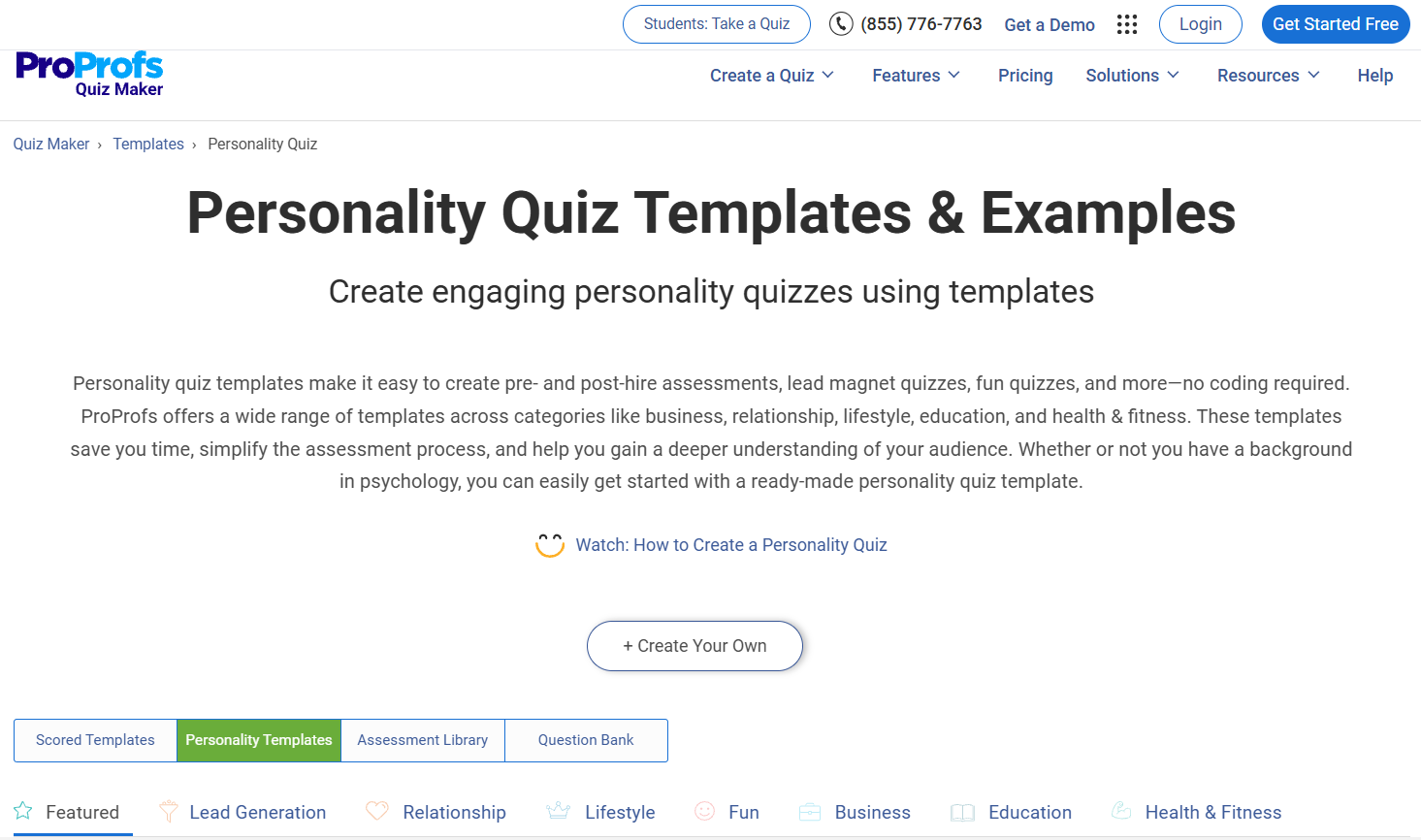
If you want to evaluate reasoning ability or problem-solving alongside personality traits, switch to the Assessment Library tab to add psychometric assessments into your hiring workflow.
This allows you to assess both how candidates think and how they behave.
Step 2: Define Job-Relevant Personality Traits
Click Personality → New Personality to create your result categories.
These are not casual personality labels. They should reflect behavioral drivers that directly impact job performance.
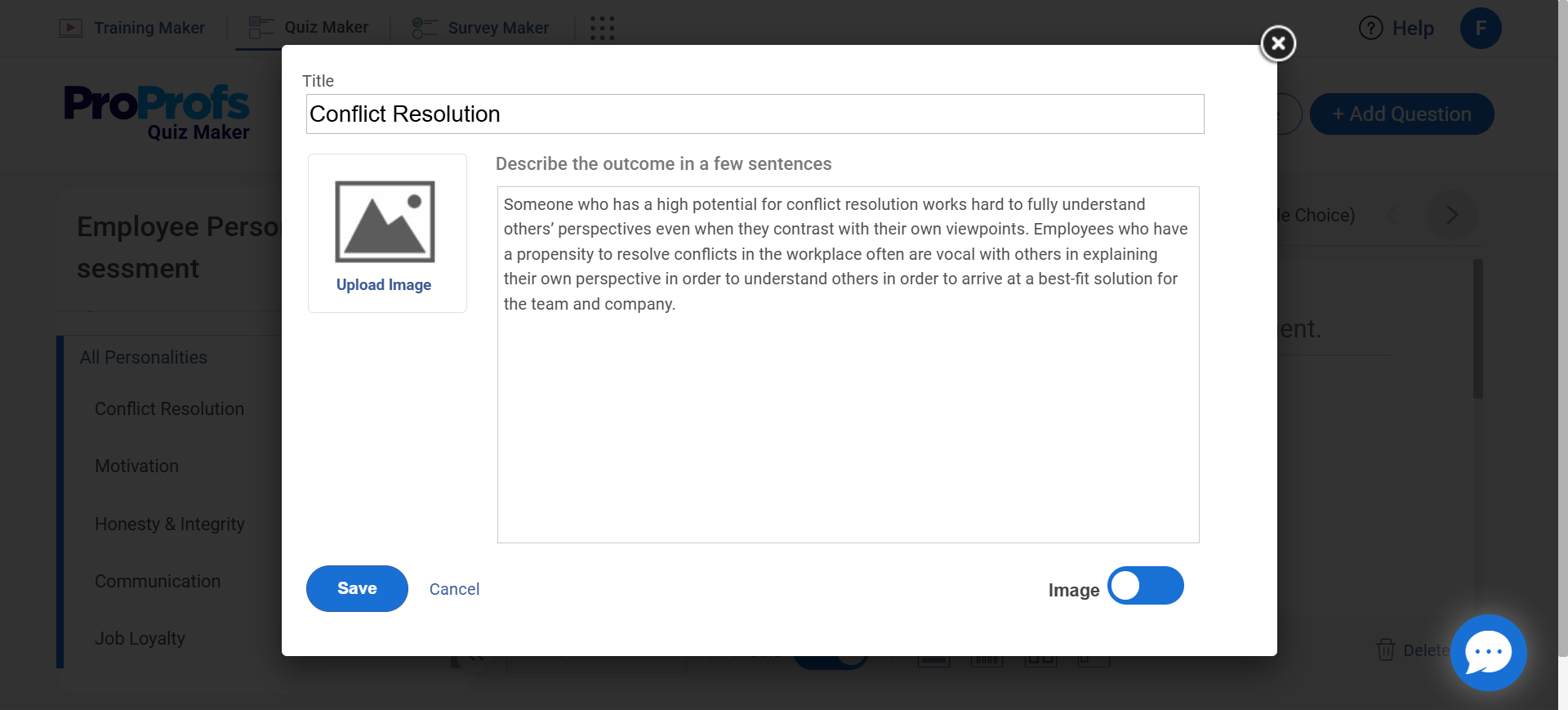
Examples:
- Conscientiousness (execution reliability)
- Emotional Stability (stress handling)
- Collaboration (team interaction)
- Initiative (ownership mindset)
- Integrity (ethical decision-making)
For each personality type:
- Write a description tied to workplace behavior
- Clarify what high and low scores indicate
- Keep traits aligned with actual role demands
Avoid adding traits that sound impressive but are not measurable in your questions.
A focused trait framework improves interpretability for hiring panels.
Step 3: Design Scenario-Based Questions
Click New Question and choose the format that fits your scenario:
- Multiple choice
- Checkbox
- True/False
- Media-based (image or video supported)
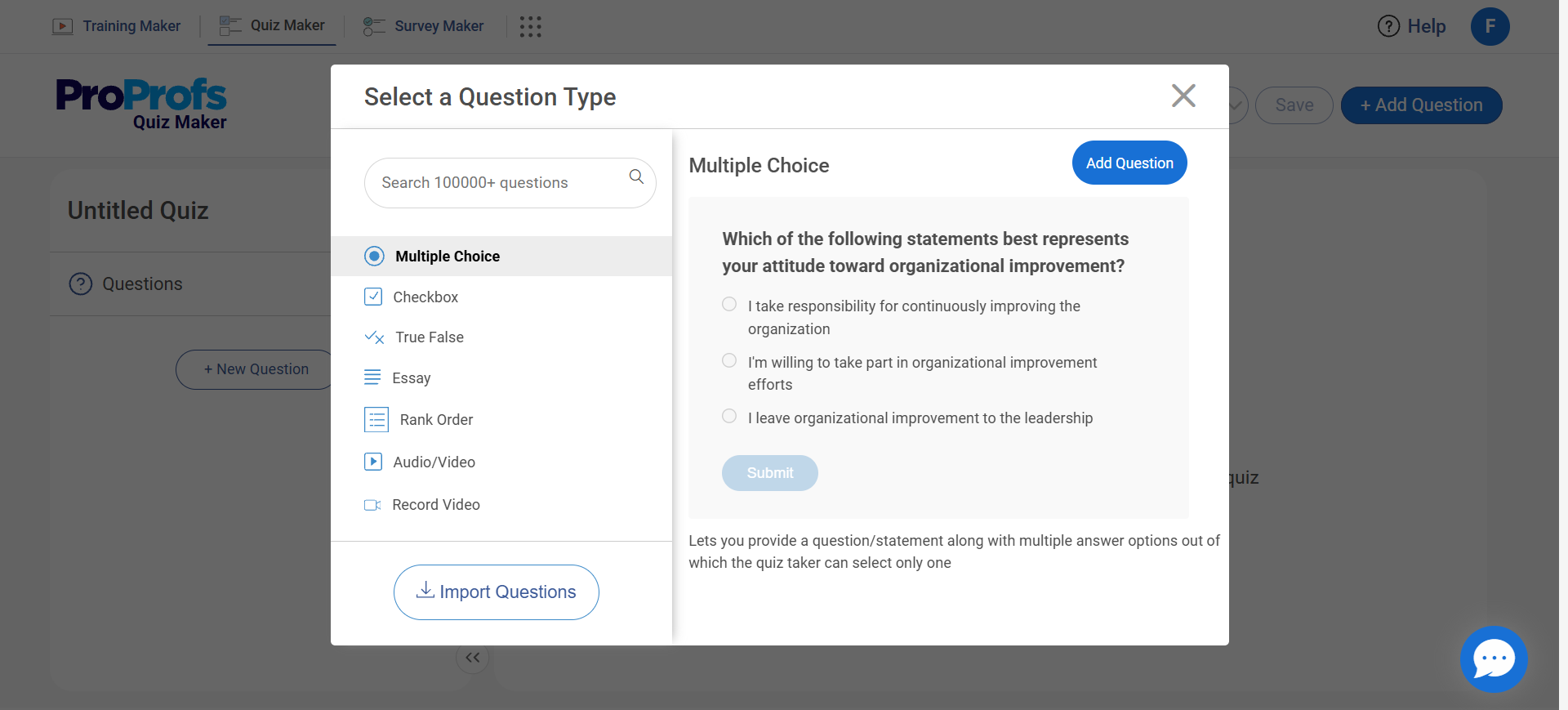
Use short, realistic work situations instead of abstract personality statements.
Stronger example:
A client escalates an issue publicly. How do you respond?
Each option should represent a distinct behavioral tendency, not obvious “right” answers.
Tip: Keep options behaviorally balanced. Overly extreme answers reduce assessment accuracy.
Step 4: Activate Advanced Scoring & Map Traits
Open a question → Click Edit Question → Enable Advanced Scoring.
Now assign weighted points to each answer.
Example:
- Option A → 5 points to Conscientiousness
- Option B → 3 points to Initiative
- Option C → 2 points to Emotional Stability
- Option D → 4 points to Conscientiousness and 2 points to Collaboration
A single answer can contribute to multiple traits. This mirrors real workplace behavior, where actions often reflect overlapping characteristics.
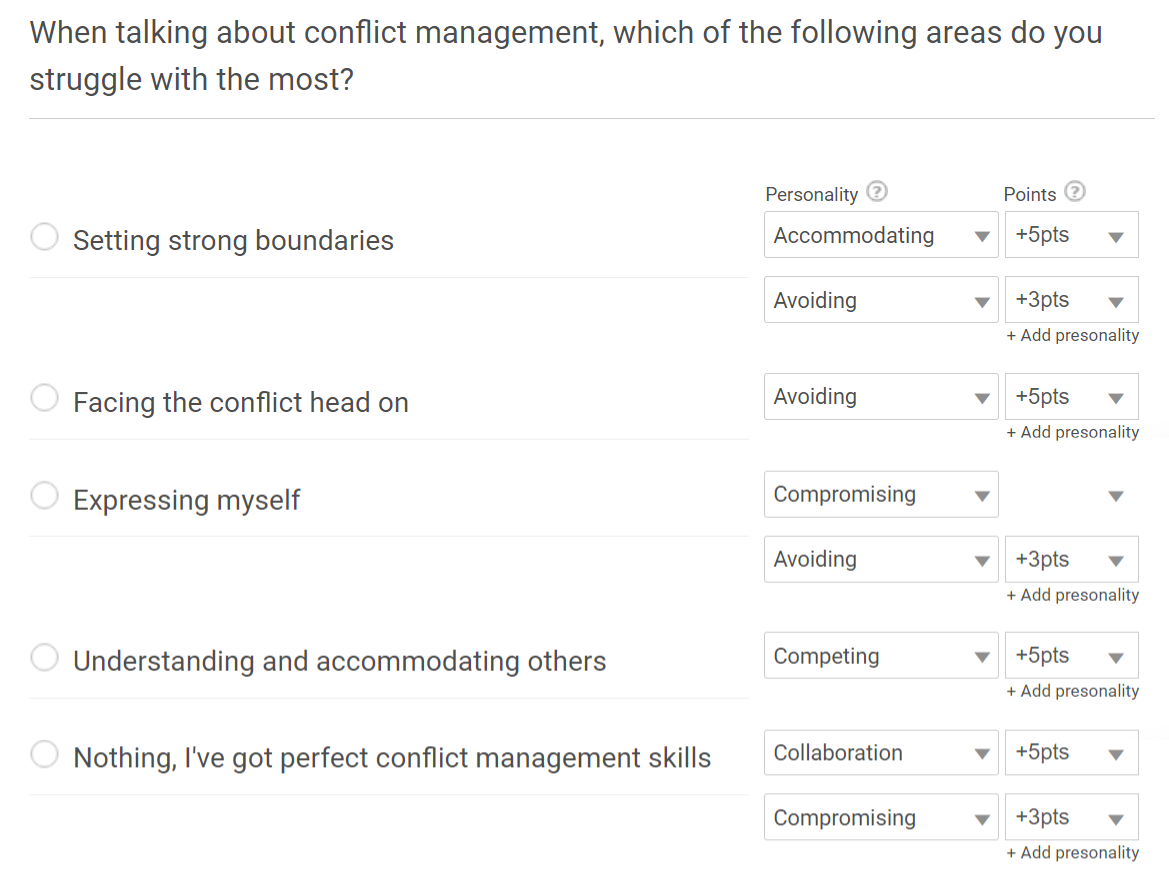
Weight responses based on impact. For example:
- Ownership under pressure may deserve higher weighting.
- Passive cooperation may deserve moderate weighting.
Avoid designing scoring where the most extreme response always scores highest. Balanced behavioral responses often predict performance more accurately.
At completion, ProProfs automatically aggregates points across all traits.
Step 5: Translate Scores into Hiring Decisions
Instead of simply displaying top traits, configure structured hiring outcomes.
Go to:
Settings → Enable “Show analysis based on the score achieved for a personality.”
Define score thresholds aligned to job expectations.
Example framework:
- 70% and above on core traits → Strongly Recommended
- 45%–69% → Recommended with Review
- Below 45% → Further Evaluation Required
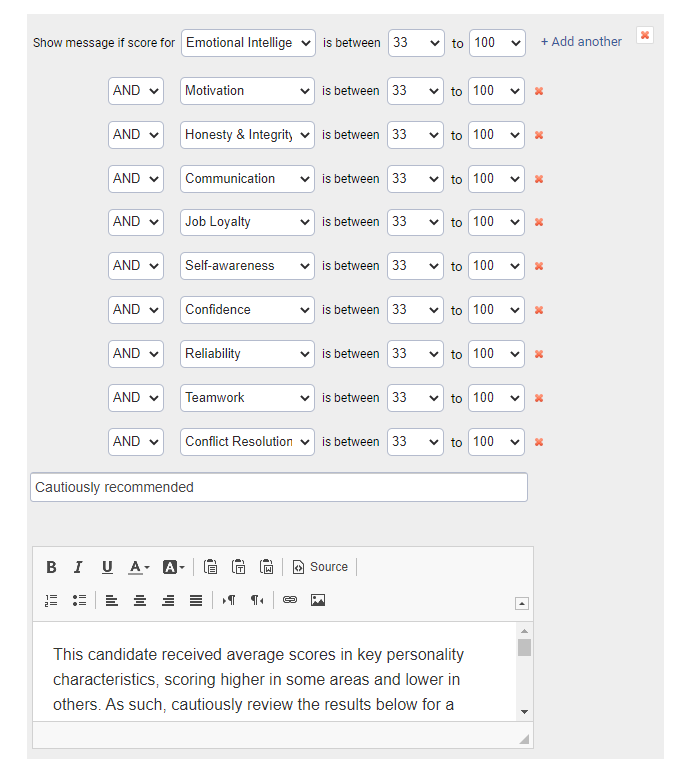
Tie these thresholds to actual performance benchmarks inside your organization.
For each range:
- Assign the personality parameter
- Define score boundaries
- Add a structured interpretation message for hiring managers
This converts raw personality data into decision-ready guidance.
Step 6: Configure Reporting for Hiring Teams
Navigate to:
Settings → General Settings → Reports & Results
Here you determine how insights are delivered.
You can:
- Show dominant personality outcomes
- Display trait-level score breakdowns
- Control candidate visibility of results
- Add internal interpretation notes
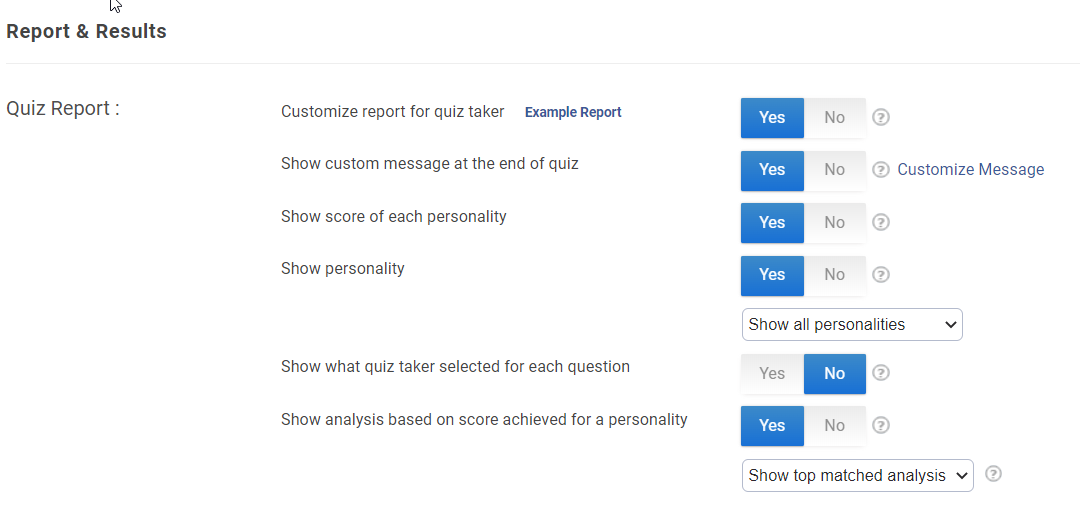
For hiring purposes, consider:
- Showing outcome categories to candidates
- Keeping weighted score logic internal
- Exporting reports for panel discussions
You can also enable score-based analysis per trait, allowing hiring managers to see deeper behavioral interpretation based on defined thresholds.
This helps prevent over-reliance on a single personality label.
Step 7: Validate Before Deployment
Before using the test in live hiring:
- Run it with high-performing employees in the target role
- Compare their scoring patterns
- Identify trait ranges associated with success
- Adjust weighting if needed
Use internal benchmarking rather than assumptions when finalizing scoring logic.
Once validated, click Save to activate the assessment.
ProProfs will automatically score, categorize, and generate structured reports for every candidate.
By combining weighted scoring, multi-trait mapping, recommendation thresholds, and configurable reporting inside ProProfs Quiz Maker, you create a personality assessment that supports consistent, defensible, and role-specific hiring decisions.
That is when personality testing shifts from being informational to operational.
Employment Personality Test Example
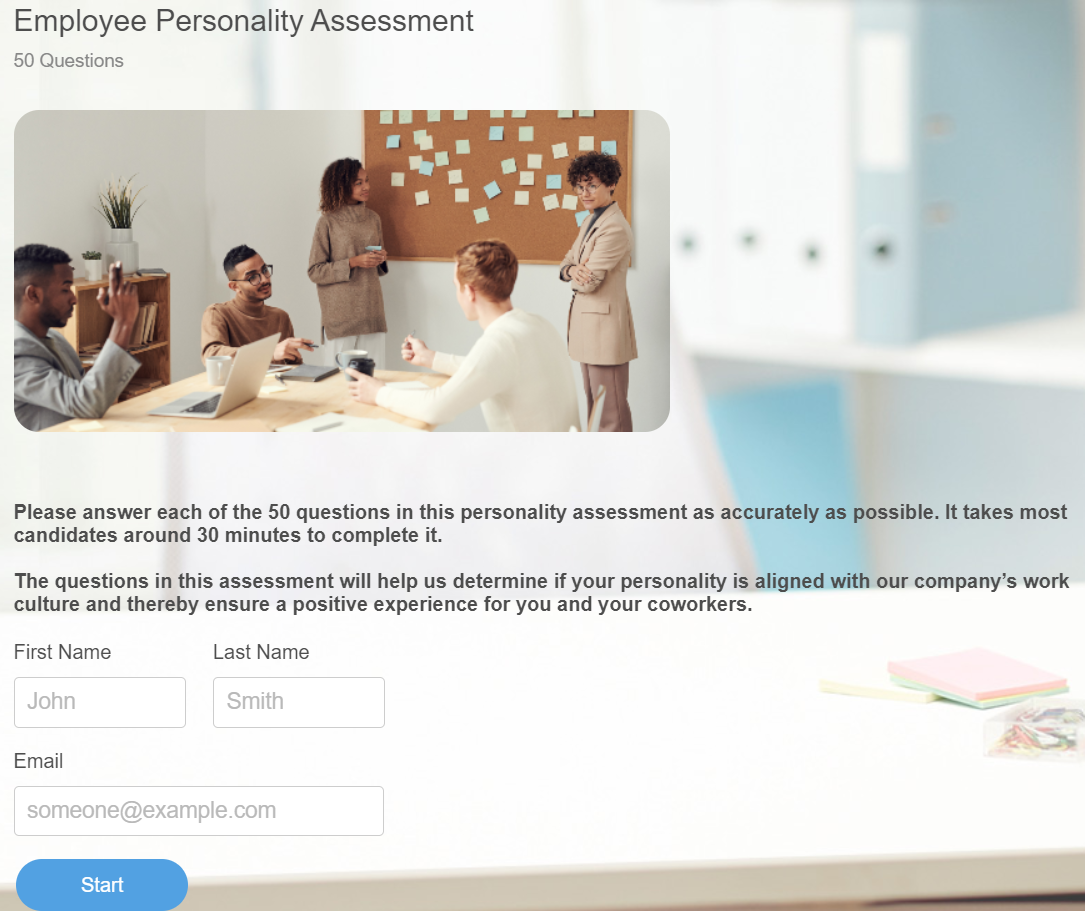
To see what a role-ready personality assessment looks like in practice, here’s an example of a pre-employment test built with ProProfs Quiz Maker.
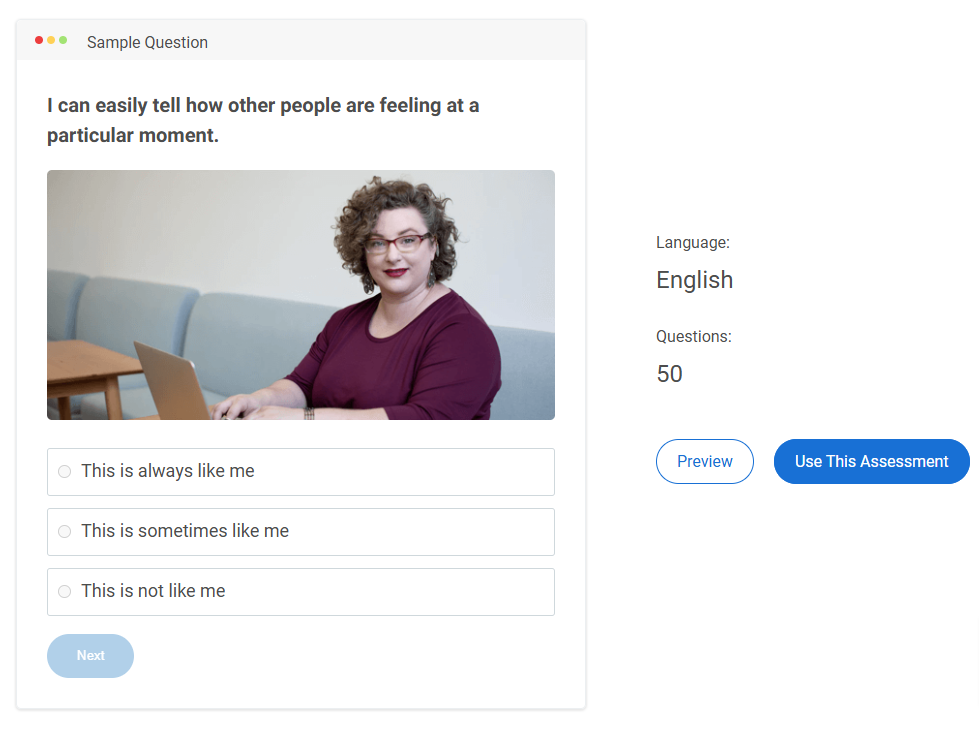
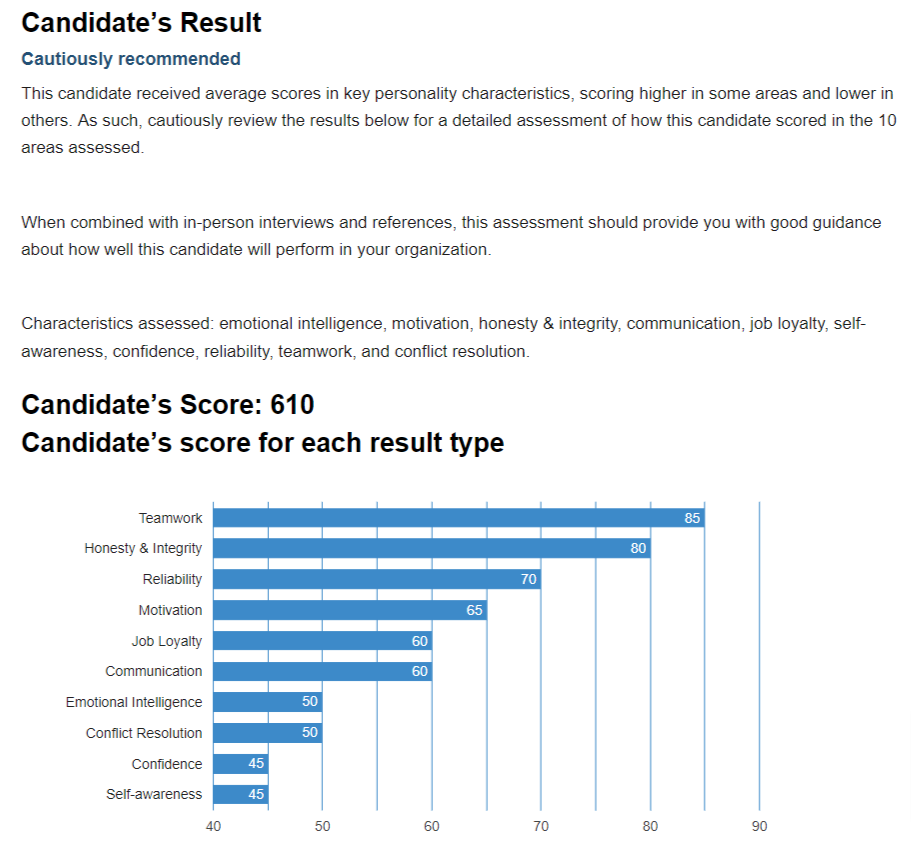
This sample assessment includes 50 multiple-choice questions and measures 10 workplace-relevant personality traits, such as emotional intelligence, integrity, teamwork, and conflict resolution.
A Selection of the Questions
Check out a few questions from this assessment, along with the personality traits that they target.
1. Personality Trait Assessed – Emotional Intelligence
Question/Statement – I can easily tell how other people feel at a particular moment.
Answer Options:
- This is always like me
- This is sometimes like me
- This is not like me
2. Personality Trait Assessed – Honesty and Integrity
Question/Statement – If a coworker consistently left early without following the protocol for doing so, would you cover for them?
Answer Options:
- Never
- Sometimes
- Always
3. Personality Trait Assessed – Confidence
Question/Statement – You are starting in a new position that requires you to perform tasks that you do not have any prior experience with. You…
Answer Options:
- Acknowledge that you are resourceful and will find others who will help you be successful on the job to learn
- Try your best to learn without bothering other people
- Decide that it’s best not to take a job for which you are not qualified
4. Personality Trait Assessed – Teamwork
Question/Statement – You’re on an urgent deadline and one of your teammates gets sick with the flu. You…
Answer Options:
- pull together a team meeting and figure out how you can work together to meet the deadline.
- say nothing and do whatever is needed, but feel resentful that your teammate isn’t pulling their weight.
- try to find out if your teammate is faking illness to avoid meeting the deadline.
5. Personality Trait Assessed – Conflict Resolution
Question/Statement – In disagreement with another person, I try and understand their perspective and position.
Answer Options:
- This is a lot like me
- This is sometimes like me
- This is never like me
What the Report Looks Like
Once a candidate completes the assessment, the results can be presented in a detailed trait-based report that shows:
- How they scored across each personality dimension
- Which options they selected
- Strength areas and potential concerns
- Patterns that can guide follow-up interview questions
This makes it easier for hiring teams to evaluate behavioral fit alongside skills and experience, rather than relying on instinct alone.
Best Practices to Leverage Pre-Employment Personality Assessments
A personality test strengthens hiring only when it is implemented thoughtfully. Poor execution creates risk. Structured use creates clarity.
1. Use Validated, Job-Relevant Assessments
Choose assessments grounded in established psychological research. Look for tools with evidence of reliability and predictive validity.
More importantly, ensure the traits measured are directly tied to job performance. Testing unrelated characteristics increases both hiring risk and legal exposure.
2. Align the Test With the Role
Avoid using the same assessment for every position. Identify which traits truly impact success in that specific role.
A sales role may require resilience and assertiveness. A customer support role may require patience and empathy. Alignment improves both relevance and defensibility.
3. Standardize the Process
Every candidate for the same role should complete the same assessment under consistent conditions.
Standardization reduces bias, strengthens fairness, and allows for meaningful comparison across applicants.
4. Use Personality Tests as One Data Point
Personality assessments should inform interviews, not replace them. Combine results with:
- Structured interviews
- Skills assessments
- Work samples
- Reference checks
Use the test to guide deeper questions, not to make automatic decisions.
5. Train Hiring Managers on Interpretation
Assessment reports require thoughtful reading. Hiring managers should understand:
- What each trait represents
- What high and low scores may indicate
- The limitations of personality testing
Focus on patterns across traits rather than single scores.
6. Communicate Clearly With Candidates
Explain the purpose of the assessment and how it fits into the hiring process. Make it clear that the test is one component of evaluation, not a judgment of character.
Clear instructions and transparency improve candidate experience and response quality.
7. Protect Privacy and Comply With Employment Laws
Store results securely and limit access to authorized stakeholders. Use assessment data strictly for employment-related purposes.
Ensure your testing practices comply with applicable employment laws and anti-discrimination regulations in your region.
8. Monitor and Refine Over Time
Track how hires perform relative to their assessment results. Over time, this helps you identify which traits truly predict success within your organization.
Hiring processes improve when they are reviewed, measured, and refined.
Limitations of Pre-Employment Personality Tests
Personality assessments add structure to hiring, but they are not a substitute for judgment. Knowing their limits helps you avoid costly mistakes.
1. They Do Not Measure Skill or Competence
Personality tests assess behavioral tendencies, not technical ability. A candidate may score high on reliability yet still lack the skills required for the role. Pair personality insights with skills evaluations.
2. Responses Can Be Managed
Some candidates answer in ways they believe are expected. Well-designed assessments reduce this, but no test fully eliminates impression management. Structured interviews help validate responses.
3. Behavior Is Context-Dependent
Personality traits are relatively stable, but workplace behavior is shaped by leadership, culture, and incentives. A low score in one area does not automatically predict failure.
4. Overreliance Leads to Oversimplification
Reducing candidates to personality scores can create blind spots. Scores indicate tendencies, not fixed outcomes. Hiring decisions should reflect patterns, not labels.
5. Legal Risk Is Real
If questions are not job-related or processes are inconsistent, assessments can create compliance issues. Tests must be relevant, standardized, and defensible.
Build Smarter Hiring Decisions With Structured Personality Testing
Hiring decisions shape team culture, performance, and long-term retention. Personality assessments give you structured insight into how candidates are likely to behave once the real work begins. Used alongside interviews and skills evaluations, they bring clarity to decisions that might otherwise rely too heavily on instinct.
If you want to build role-specific assessments, you need a platform that supports flexible scoring, customization, reporting, and secure delivery. ProProfs Quiz Maker allows you to create professional personality tests with advanced settings and tailored scoring models, without complexity.
With a free plan that includes full features for short quizzes, you can start designing and deploying pre-employment personality tests immediately and strengthen your hiring process with measurable structure.
Frequently Asked Questions

How do companies use personality tests in hiring?
Most companies send personality tests after resume screening and before final interviews. Results help assess work style, communication, stress response, and cultural fit. Employers typically combine these insights with interviews, skills testing, and reference checks.
How to pass a pre-employment personality test
There is no perfect personality profile. The best approach is honest, consistent answers. Trying to “game” the test often creates contradictions. Effective candidate preparation for personality tests focuses on understanding the role, not memorizing ideal responses.
What should candidates expect in a personality test for a job interview?
Most tests include agreement-scale statements, workplace scenarios, and behavioral preference questions. They measure tendencies, not technical skills. Some are untimed, while others have a reasonable time limit. The goal is to understand how someone approaches work situations.
What are some pre-employment assessment tips candidates should follow?
Read instructions carefully, answer consistently, and avoid overthinking. Pre-employment assessment tips usually emphasize authenticity, since most tests are designed to detect extreme or inconsistent responses.
Are personality tests fair and legal?
Yes, when used responsibly. Employers must ensure assessments are job-related, applied consistently, and compliant with employment regulations. Tests should support fair evaluation, not introduce bias or replace other hiring methods.

Let ProProfs AI Build a Quiz

 We'd love your feedback!
What did you like & how can we make it even better?
 Thanks for your feedback!
 Ask Your Question
Have a question? Get expert help to make your decision easier.